POV (Point of View)
How AI Will Reshape Enterprise Strategy
March 31, 2026
/
3 min
AI will not replace strategy teams. But it will reshape how strategy gets done. In this article, we dive deep into the current state of enterprise strategy and what leadership should do to make strategy more actionable and better embedded in the business.
BCG put it well: “80% of strategy tasks are exposed to Al automation (information, processing, modelling, etc.). But the real revolution isn't Al replacing corporate strategists-it's Al fundamentally transforming how strategy itself is created.”
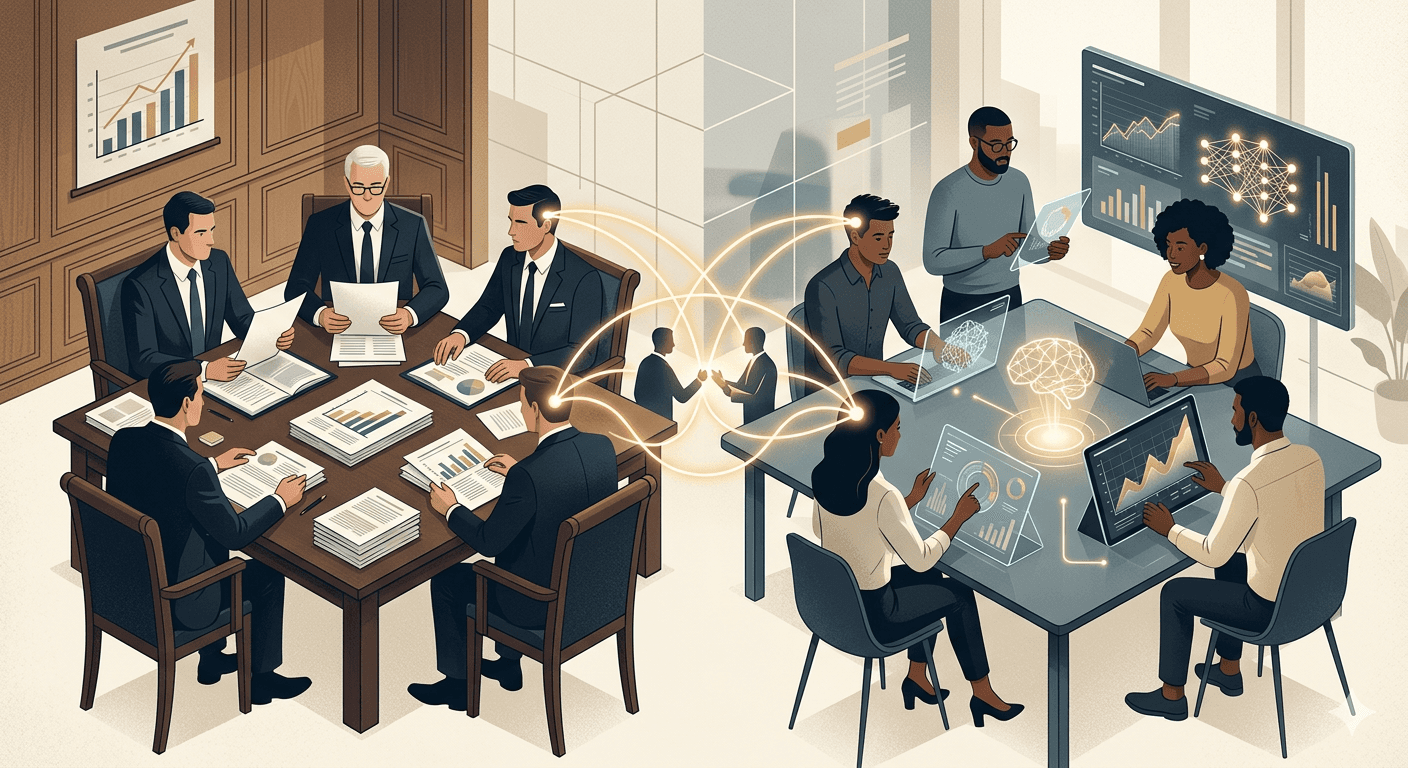
For years, enterprise strategy has followed a familiar pattern. A small group of leaders or strategists defines the problem, gathers inputs across the business, synthesizes findings, and then translates them into a set of recommendations. The process can be thoughtful and rigorous, but it is often slow and may not meet the growing needs of business units who need strategy to execute.
AI changes that equation. Not because strategy no longer needs human judgment. But because AI can now take on much more of the heavy lifting across research, synthesis, structuring, and analysis. That opens the door to a very different model: one where strategy is faster, more distributed, and more deeply grounded in the real context of the business units.
What Is the Current State of Enterprise Strategy
“Do nothing”: An estimated 15%–20% of SMBs make strategic decisions reactively, without any structured process.
“Do it ourselves”: An estimated 30%–35% of scaling business leaders in 50–200 employee companies handle strategic decisions internally, relying on peer networks, self-directed research, and ad hoc AI tools. While there is no single authoritative survey for this exact segment, multiple signals point in this direction. Many SMB owners rely heavily on professional networks and peer groups for guidance, and generative AI adoption among SMBs has risen quickly. But there is still a major trust and quality gap when leaders rely on generic AI tools for high-stakes strategy work.
Outsourced consulting teams: Traditional consulting can bring structured thinking, but it often comes with high overhead. External teams also lack the day-to-day workflow context and the undocumented knowledge that lives only in the heads of employees.
In-house corporate strategy: Even when an internal strategy team has strong company context, strategy projects often take 3–6 months or longer. That pace may not match the speed required to respond to changing markets. On top of that, in large companies, every business unit may need strategic support, while corporate strategy teams are often focused primarily on C-level priorities.
What Leadership Should Do Differently
Create strategy from within the team: The best strategy is rarely created in isolation from the people doing the work. Strong strategic thinking should be built with the internal team, because they bring the contextual judgment, problem framing, and result interpretation that AI alone cannot provide. These are the capabilities that help organizations capture the full value of AI across real workflows and systems.
Empower teams with the right AI tools: Internal teams already have business context and operating knowledge. What they often lack is structured tools that help them think strategically, evaluate trade-offs, and build strategy that is tailored to the business and ready for implementation.
How NitroLens AI Fills the Gap
Consulting-grade methodology, built into the AI: NitroLens AI guides users step by step through proven business frameworks to produce actionable strategic guidance. Instead of static dashboards or one-off chatbot outputs, NitroLens supports the full strategic analysis process: clarifying the real problem, pressure-testing assumptions, incorporating stakeholder input, and validating outputs. The result is strategy tailored to the business’s actual bottlenecks.
Democratizing strategy across the business: Every team can have an in-flow strategy partner that understands its day-to-day activities, context, and knowledge base, while applying a framework-driven and hypothesis-driven methodology to run rigorous analysis end to end. Strategy becomes embedded in the real workflow, shaped by internal stakeholder insight, validated through internal and external inputs, and ultimately designed for implementation by the same team that helped create it.
This is where enterprise strategy is heading. Not toward a future where AI replaces people, but toward one where AI makes high-quality strategic thinking more accessible and affordable across the organization. The bottleneck will no longer be access to frameworks or polished outputs. It will be whether companies can combine AI speed with human judgment, internal context, and execution discipline.
The companies that win will not be the ones that simply use more AI. They will be the ones that redesign how strategy gets done: moving it closer to the teams, grounding it in real operating context, and using AI to make the process faster, more rigorous, and more actionable.
That is the mission of NitroLens AI and the gap it is built to fill.