POV (Point of View)
Stop Using SWOT Like This
March 24, 2026
/
3 min
SWOT is a useful framework, but too often teams stop at the slide and call it strategy. We break down the most common mistakes teams make with SWOT and how to use it the right way to lead to a validated, action-ready strategy.
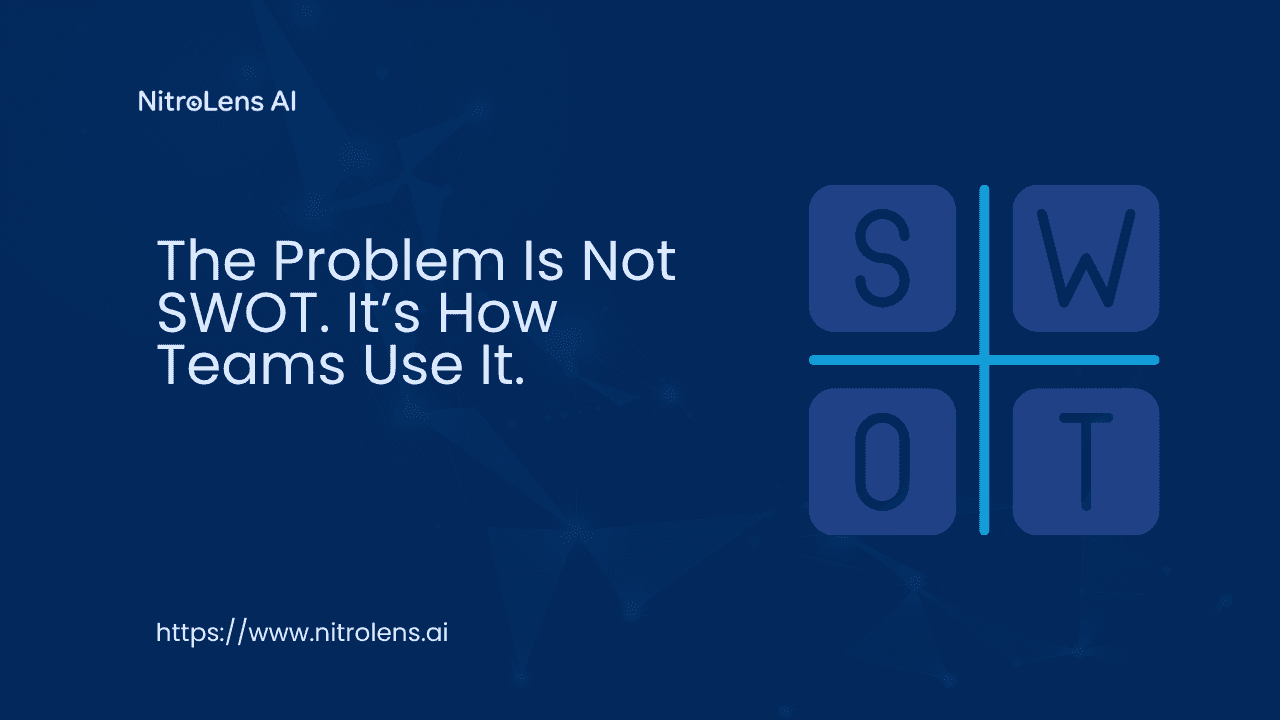
SWOT is one of the most common analytical frameworks.
It stands for strengths, weaknesses, opportunities, and threats.
SWOT helps teams organize what is happening inside the business and outside in the market. It helps teams structure discussion, surface key issues, and frame the questions that strategy needs to answer. It gives people a simple way to step back, look at the full picture, and think more clearly.
But this is also where the problem starts.
A lot of teams treat SWOT as if it is the strategy.
It is not.
Common Mistakes People Make with SWOT
One mistake is treating SWOT as the final answer instead of an input into final strategy.
That is where teams get into trouble. A polished SWOT can look thoughtful and complete, but that does not mean the strategy is done. It just means the team has organized some inputs. The real work still comes after that: analysis, validation, prioritization, trade-offs, and then execution.
Another mistake is filling each box with vague or generic statements.
Things like “strong brand,” “good team,” or “market growth” may sound useful, but they are often too loose to support real decisions. Teams also tend to list points too early, before doing enough research or testing assumptions.
Then they move straight from a quick SWOT into action plans.
That is risky.
Because if the inputs are weak, the recommendations will not hold up.
A third mistake is poor structure.
SWOT is MECE across its four quadrants. But a strong SWOT should also be MECE within each quadrant. The points inside each box should not overlap, mix levels, or leave obvious gaps. If the structure is messy, the thinking will be messy too.
And even when the discussion sounds smart, the output often falls short.
The recommendations may sound reasonable, but they are not always prioritized, practical, or tied to execution. The team ends up focusing on finishing the framework instead of producing something that works in the real world.
What We Should Do Instead
SWOT is a structure thinking tool, not a decision-ready strategy.
Its job is to help surface the most important strategic questions.
Each point in the SWOT should be clear, specific, and backed by evidence.
The structure should be MECE, so the analysis is complete without being repetitive.
And most importantly, the output of SWOT should be treated as a set of hypotheses.
That means we need to gather data, test assumptions, compare options, and make real choices. From there, the team can turn insights into priorities, trade-offs, and specific actions.
SWOT is useful, but only when we use it the right way.
At NitroLens, framework thinking is the starting point. From there we surface the right questions, pressure-testing hypothesis, structuring analysis, conducting stakeholder interviews, and validating assumptions, ensuring the outputs are rooted in your real business context and clear for implementation.